
Cosmetic Filler Ingredients: What You Need to Know


Cosmetic filler ingredients are bioengineered substances injected beneath the skin to restore lost volume, smooth wrinkles, and improve skin texture. The industry term for these products is “dermal fillers,” and understanding what is cosmetic filler ingredient means knowing which compounds do what inside your skin. Dermal fillers rank as the second most popular non-surgical cosmetic procedure in the US, with over 3.4 million treatments performed annually. That number tells you this is not a niche trend. It is a mainstream aesthetic choice, and knowing the ingredients behind it puts you in a much stronger position before any consultation.
What are the main types of cosmetic filler ingredients?
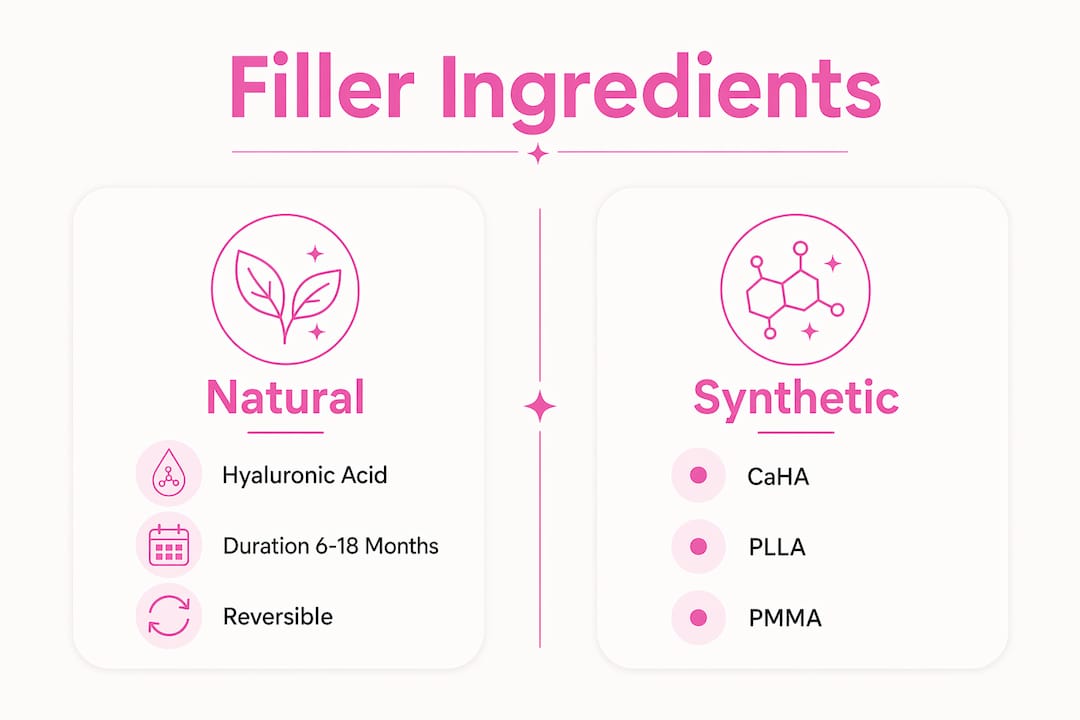
The four primary FDA-approved filler ingredients are Hyaluronic Acid (HA), Calcium Hydroxylapatite (CaHA), Poly-L-Lactic Acid (PLLA), and Polymethylmethacrylate (PMMA). Each one works differently, lasts a different length of time, and suits different treatment goals. Fat transfer is also used as a biological alternative, using your own tissue rather than a synthetic compound.
Here is a quick breakdown of the four main types:
- Hyaluronic Acid (HA): A naturally occurring sugar molecule found in your skin and joints. HA attracts and holds water, creating instant volume and hydration. It lasts 6–18 months and is fully reversible.
- Calcium Hydroxylapatite (CaHA): A mineral compound similar to what makes up your bones. It provides structural support and stimulates collagen production. It lasts 12–18 months.
- Poly-L-Lactic Acid (PLLA): A synthetic, biodegradable compound that triggers your body to produce its own collagen over time. Results develop gradually and can last up to 2 years.
- Polymethylmethacrylate (PMMA): Tiny synthetic microspheres suspended in a collagen gel. They create a semi-permanent framework beneath the skin and last 5 or more years.
| Ingredient | Origin | Duration | Best For |
|---|---|---|---|
| Hyaluronic Acid | Natural (sugar molecule) | 6–18 months | Lips, fine lines, cheeks |
| Calcium Hydroxylapatite | Mineral-based | 12–18 months | Deeper wrinkles, jawline |
| Poly-L-Lactic Acid | Synthetic, biodegradable | Up to 2 years | Volume loss, facial contouring |
| Polymethylmethacrylate | Synthetic microspheres | 5+ years | Deep wrinkles, scars |
Pro Tip: Ask your provider whether lidocaine is included in your filler formula. Lidocaine added directly to fillers significantly improves comfort during injection without affecting your results.
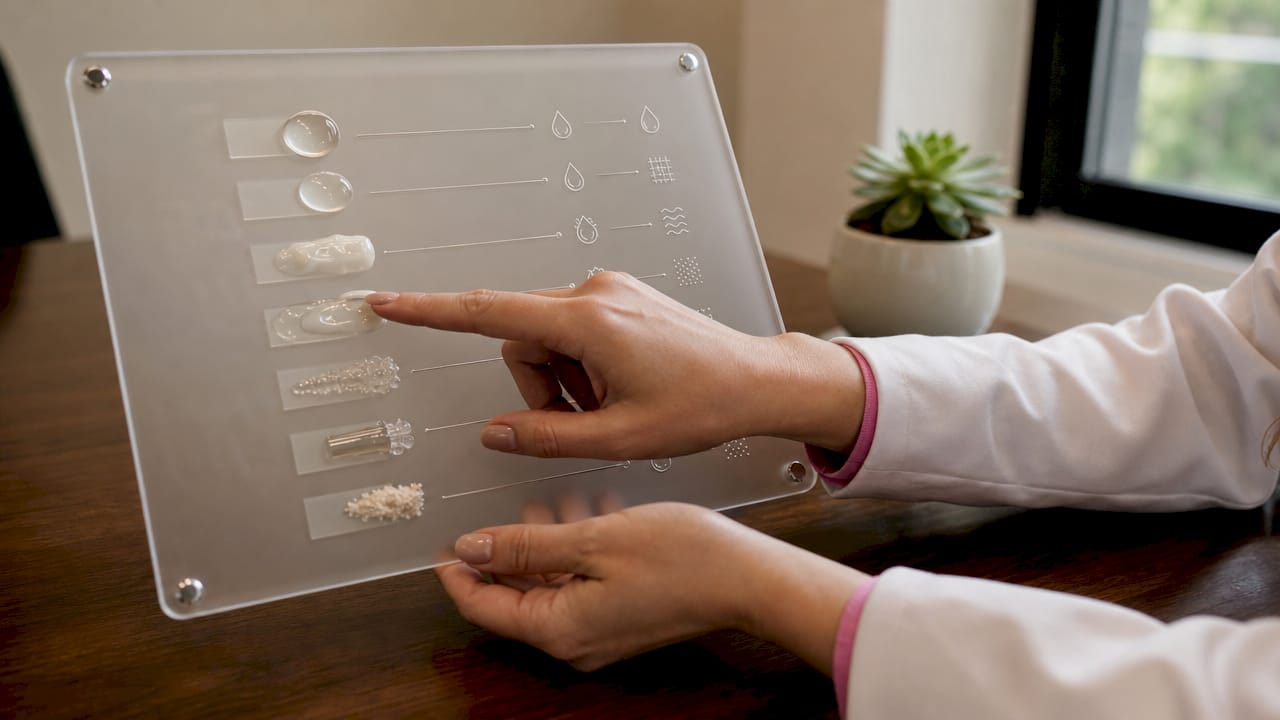
How do cosmetic filler ingredients work in the skin?
Each filler compound works through a distinct mechanism. Understanding these differences helps you set realistic expectations before your appointment.
- Hyaluronic Acid binds water molecules at a ratio of up to 1,000 times its own weight. When injected, it physically fills the space beneath the skin and pulls in moisture, creating immediate plumpness. The effect is visible right away.
- Calcium Hydroxylapatite works in two stages. First, the gel carrier provides instant volume. Then, the mineral microspheres act as a scaffold that stimulates your body’s own collagen production over the following weeks. This dual action makes it effective for deeper structural work.
- Poly-L-Lactic Acid does not add volume directly. Instead, PLLA stimulates collagen production gradually, with results developing over several months and typically requiring multiple sessions. The payoff is a natural-looking improvement that builds over time.
- Polymethylmethacrylate microspheres are not absorbed by the body. PMMA creates a semi-permanent framework that physically supports the skin from below, making it one of the longest-lasting options available.
- Rheology is the science of how a substance flows and behaves under pressure. Biphasic fillers have a particle-based structure that provides strong lifting power, while monophasic fillers are smoother and better suited for areas with a lot of movement, like around the mouth.
The rheological properties of a filler determine how it feels under the skin and how well it holds up in areas that move frequently. A filler that works beautifully in the cheeks may be the wrong choice for the lips. This is why the ingredient type alone does not tell the whole story. How the product is manufactured matters just as much.
Pro Tip: Cross-linking technique in HA fillers critically affects how the product performs. Biphasic cross-linking gives stronger lift; monophasic cross-linking gives a softer, more fluid result. Ask your provider which type they are using and why.
What safety considerations exist for filler ingredients?
Safety in cosmetic fillers comes down to two things: ingredient reversibility and injector skill. These two factors shape your risk profile more than anything else.
Hyaluronic Acid fillers hold a clear safety advantage because they are fully reversible. HA fillers can be dissolved with hyaluronidase, an enzyme that breaks down the filler quickly if a complication occurs or if you simply change your mind. Clinical guidelines recommend HA fillers for first-time patients for exactly this reason.
Non-HA fillers like CaHA, PLLA, and PMMA cannot be dissolved. Once injected, they must be managed rather than reversed. This makes provider experience especially critical with these compounds.
Key safety points every patient should know:
- Reversibility: Only HA fillers can be dissolved. All other types require waiting for natural absorption or, in rare cases, surgical correction.
- Radiopacity: Calcium Hydroxylapatite is radiopaque and can interfere with CT and MRI scans. Always disclose your filler history to any medical professional before imaging.
- Injector skill: PMMA requires a highly experienced injector. Placement errors with semi-permanent fillers are difficult to correct.
- Consultation: A thorough consultation should cover your medical history, current medications, skin type, and treatment goals before any filler is chosen.
Choosing the right filler ingredient is not just about the result you want. It is about matching the ingredient’s safety profile to your personal risk tolerance, your anatomy, and the skill level of your provider. A reversible filler in the hands of a less experienced injector is often safer than a longer-lasting one with an expert, simply because the margin for error is wider.
How do practitioners and patients select the right filler ingredient?
Filler selection balances ingredient chemistry and rheology with patient anatomy and aesthetic goals. No single ingredient is universally best. The right choice depends on where you are treating, what result you want, and how long you want it to last.
Matching filler to treatment area
High-mobility areas like the lips and around the mouth need softer, more flexible fillers. Monophasic HA fillers work well here because they move naturally with facial expressions. Structural areas like the cheeks and jawline benefit from biphasic fillers or CaHA, which offer stronger lift and longer support.
Short-term vs. long-term strategies
Patients new to fillers often benefit from starting with a shorter-duration HA product. This lets you see how your face responds and adjust in future sessions. Patients with established filler experience and clear aesthetic goals may prefer PLLA or CaHA for longer-lasting results with fewer maintenance appointments.
| Factor | Short-Term Strategy | Long-Term Strategy |
|---|---|---|
| Ingredient | Hyaluronic Acid | PLLA, CaHA, or PMMA |
| Duration | 6–18 months | 1–5+ years |
| Reversibility | Yes, with hyaluronidase | No |
| Best for | First-timers, dynamic areas | Experienced patients, structural areas |
| Risk profile | Lower | Higher, requires skilled injector |
Skin type and aging pattern also guide ingredient choice. Patients with significant volume loss respond well to PLLA because it rebuilds collagen over time rather than simply filling a space. Patients seeking a quick refresh before an event are better served by HA for its immediate effect.
Key Takeaways
The safest and most effective cosmetic filler ingredient choice depends on matching the compound’s mechanism, duration, and reversibility to your specific anatomy and goals.
| Point | Details |
|---|---|
| Four FDA-approved types | HA, CaHA, PLLA, and PMMA each work differently and last different lengths of time. |
| HA is the safest starting point | Hyaluronic Acid is the only filler type reversible with hyaluronidase enzyme. |
| Rheology determines placement | Biphasic fillers lift; monophasic fillers flow. Match the type to the treatment area. |
| Disclose filler history | CaHA is radiopaque and can interfere with medical imaging scans. |
| Injector skill is non-negotiable | Long-lasting fillers like PMMA require high provider expertise to avoid complications. |
What I have learned about filler ingredients that most guides skip
Most articles on this topic stop at listing the four ingredient types and calling it done. What they miss is the manufacturing layer, and that is where the real differences live.
Two HA fillers from different manufacturers can feel completely different under the skin, last different lengths of time, and produce different aesthetic results. The reason is cross-linking. Manufacturing differences in cross-linking technique affect how the filler flows, how much lift it provides, and how long it holds up. This is not a minor detail. It is the difference between a result that looks natural and one that looks stiff.
The evolution of fillers moves beyond simple volume replacement toward functional aesthetics, including biological stimulation and long-term skin quality improvement. PLLA is a great example. Patients often underestimate it because results are not immediate. But the collagen it stimulates is your own tissue, and that tends to look and feel more natural than a gel sitting beneath the skin.
My honest advice: go into your consultation knowing which ingredient category interests you and why. Ask your provider about cross-linking type for HA fillers. Ask about their experience with PMMA specifically if that is on the table. The ingredient is only as good as the hands delivering it.
— My
Complement your filler results with Mytubescosmetics
After a filler treatment, your skin deserves makeup that works with it, not against it. Mytubescosmetics makes cruelty-free products built for melanin-rich skin, and they pair beautifully with the lifted, refreshed look that fillers create.

A bold lip is one of the fastest ways to highlight the results of lip filler. The Mytubescosmetics matte lipstick delivers rich, no-transfer color that stays put and lets your filler work do the talking. And if filler is not on your list, a high-shine gloss like My TLips – Lip Lustre Gloss gives lips the look of extra fullness on its own—the shine plays up dimension, no appointment needed. For a full glow moment, the Mytubescosmetics best sellers include foundations, highlighters, and lip products formulated to complement your skin’s natural radiance. Real color, real coverage, real you.
FAQ
What is a cosmetic filler ingredient?
A cosmetic filler ingredient is a bioengineered or naturally derived substance injected beneath the skin to restore volume, smooth wrinkles, or stimulate collagen. The four FDA-approved types are Hyaluronic Acid, Calcium Hydroxylapatite, Poly-L-Lactic Acid, and Polymethylmethacrylate.
How long do different filler ingredients last?
HA fillers last 6–18 months, CaHA lasts 12–18 months, PLLA results can last up to 2 years, and PMMA provides semi-permanent results lasting 5 or more years.
Are cosmetic filler ingredients safe?
FDA-approved filler ingredients are considered safe when administered by a trained provider. Hyaluronic Acid fillers carry the lowest risk profile because they are reversible with hyaluronidase if complications arise.
Can filler ingredients be removed after injection?
Only Hyaluronic Acid fillers can be dissolved using the enzyme hyaluronidase. CaHA, PLLA, and PMMA are not dissolvable and must be absorbed naturally over time or managed by a medical professional.
What should I tell my doctor before getting fillers?
Always disclose your full medical history, current medications, and any previous filler treatments. Calcium Hydroxylapatite is radiopaque and can interfere with CT and MRI scans, so your imaging team needs to know about it before any diagnostic procedure.
Recommended
- News– My Tubes Cosmetics
- My TFace | My Tubes Cosmetics
- My Glitties – Gimme Some Chunky Cosmetic Glitter | My Tubes Cosmetics


